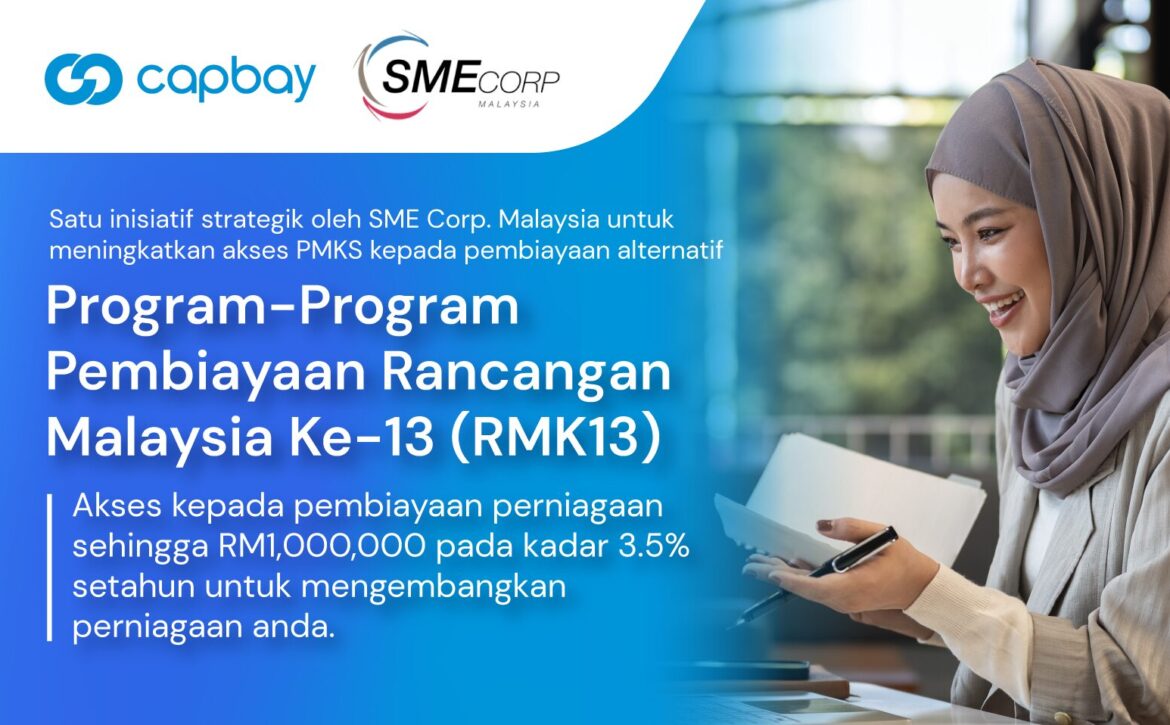
CapBay dan SME Corp. Malaysia Lancar Program Pembiayaan RMK13: Memperkasa PMKS dengan Kadar Tetap 3.5% dan Rebat Sehingga 30%

Dalam langkah strategik untuk memacu pertumbuhan Perusahaan Mikro, Kecil, dan Sederhana (PMKS) Malaysia, CapBay telah bekerjasama secara rasmi dengan SME Corp. Malaysia untuk melancarkan siri inisiatif pembiayaan berimpak tinggi. Dilancarkan sebagai sebahagian daripada Rancangan Malaysia Ke-13 (RMK13), program-program ini dilaksanakan di bawah mandat Kementerian Pembangunan Usahawan dan Koperasi (KUSKOP).

Di saat landskap perniagaan Malaysia beralih kepada pembuatan bernilai tinggi, inovasi digital, dan pematuhan ESG, kerjasama ini menyediakan kecairan modal yang kritikal untuk merapatkan jurang pembiayaan. Dengan kadar keuntungan tetap hanya 3.5% p.a. dan rebat berasaskan prestasi sehingga 30%, inisiatif RMK13 ini menandakan mercu tanda penting dalam kerjasama strategik antara pihak kerajaan dan sektor swasta bagi PMKS Malaysia.

Pembiayaan Inovatif Untuk Pertumbuhan

Berbeza dengan pinjaman tradisional yang sering mempunyai syarat ketat dan tempoh menunggu yang lama, program RMK13 melalui CapBay direka untuk kepantasan dan ketelusan:

Kadar Tanpa Tandingan: Nikmati kadar tetap 3.5% p.a.

Ganjaran Prestasi: Terima rebat sehingga 30% ke atas baki pembiayaan anda dengan mencapai sasaran pertumbuhan tertentu atau mengekalkan rekod bayaran balik yang cemerlang.

Kelulusan Digital Pantas: Gunakan platform digital CapBay untuk melengkapkan permohonan dalam talian, dengan kelulusan diproses dalam tempoh 7 hingga 14 hari.

Modal Besar: Akses pembiayaan dari RM50,000 sehingga RM1 juta dengan tempoh fleksibel sehingga 60 bulan.

Tiga Teras Utama Pembiayaan RMK13

Bagi memenuhi keperluan usahawan Malaysia yang pelbagai, inisiatif ini dibahagikan kepada tiga program utama:

1. Dana Pemangkin Penskalaan PKS (Pertumbuhan & Inovasi)

Program ini dikhaskan untuk PKS dalam sektor pertumbuhan tinggi dan nilai tinggi (HGHV) seperti Aeroangkasa, E&E, Peranti Perubatan, dan Pertanian Pintar. Ia menyediakan modal untuk:

Automasi & Industri 4.0: Penggunaan AI, robotik, dan IoT.

Inovasi: R&D, ujian produk, dan pendaftaran harta intelek (IP).

Modal Kerja: Meningkatkan skala pengeluaran untuk memenuhi permintaan pasaran.

2. PKS@kses BIAYA (Akses Pasaran)

Direka khusus untuk perniagaan yang bersedia menguasai rantaian bekalan domestik dan antarabangsa. Dana ini membantu PMKS:

  • Mengukuhkan kesiapsiagaan eksport dan memenuhi pesanan antarabangsa.
  • Membiayai aktiviti pemasaran untuk penembusan pasaran global.
  • Menyokong sektor pembuatan dan perkhidmatan dengan rekod prestasi minimum 3 tahun.

3. PKSlestari (ESG & Kelestarian)


Kelestarian bukan lagi satu pilihan. Program ini menggalakkan PMKS mengamalkan elemen Alam Sekitar, Sosial, dan Tadbir Urus (ESG) melalui pembiayaan:

  • Mesin jimat tenaga dan pemasangan panel solar.
  • Sistem pengurusan sisa dan rawatan air.
  • Audit ESG dan pensijilan hijau untuk menjamin masa depan perniagaan anda.

Mohon Dalam 3 Langkah Mudah

Proses permohonan digital CapBay yang lancar memastikan anda meluangkan kurang masa pada dokumentasi dan lebih masa untuk mengembangkan perniagaan.

Semak Kelayakan: Layari Portal RMK13 CapBay dan pastikan anda mempunyai Sijil Status PMKS dan pendaftaran SSM yang sah.

Hantar Dokumen: Muat naik salinan IC, penyata bank 6 bulan, laporan kewangan 3 tahun terkini, dan lesen perniagaan (PBT).

Terima Pembiayaan: Setelah diluluskan, dana akan disalurkan dengan pantas untuk memacu perjalanan perniagaan anda.

Peruntukan adalah terhad dan disalurkan berdasarkan ‘siapa cepat, dia dapat’. Jangan lepaskan peluang ini untuk mengembangkan perniagaan anda dengan kadar paling kompetitif di Malaysia.

Klik Di Sini Untuk Memulakan Permohonan Anda Hari Ini

*The information provided in this article is based on the current tax laws and regulations at the time of publication. As tax laws and deadlines may change, it is advisable to consult with the Inland Revenue Board of Malaysia (LHDN) or a professional tax advisor for the most up-to-date and accurate information regarding your specific circumstances.
Read More

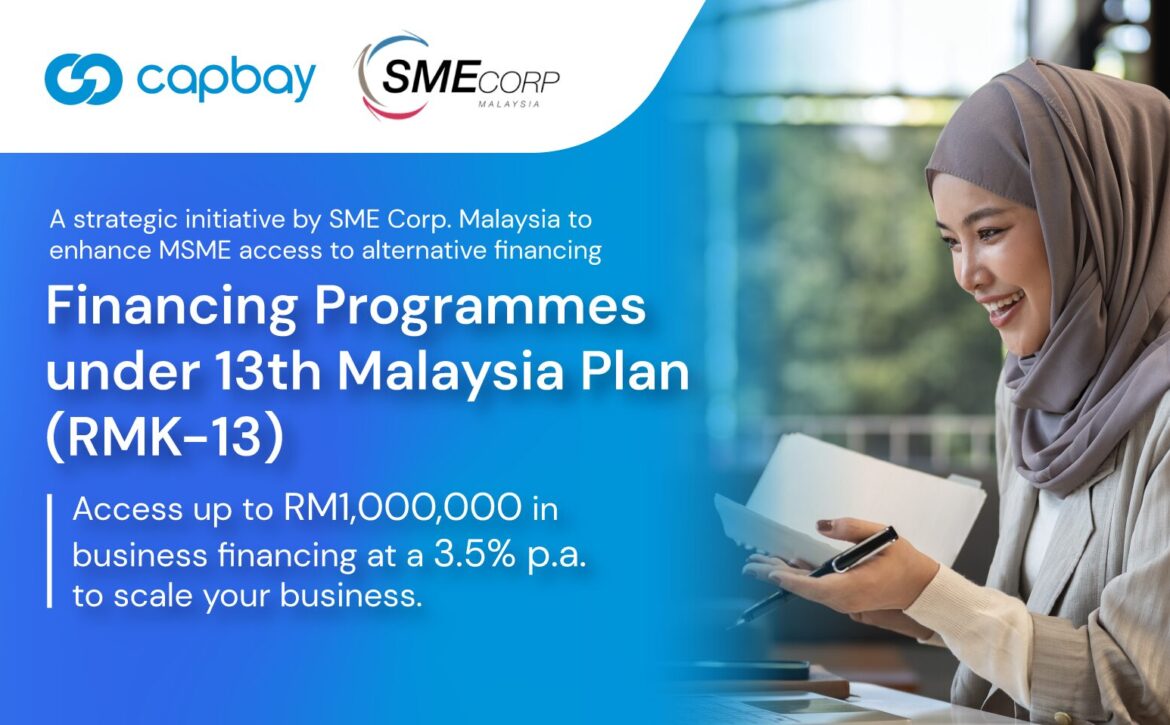
CapBay and SME Corp. Malaysia Launch RMK13 Financing Programmes: Empowering MSMEs with a 3.5% Fixed Rate and Up to 30% Rebates

In a strategic move to accelerate the growth of Malaysian Micro, Small, and Medium Enterprises (MSMEs), CapBay has officially partnered with SME Corp. Malaysia to roll out a series of high-impact financing initiatives. Launched as part of the Thirteenth Malaysia Plan (RMK13), these programmes are under the mandate of the Ministry of Entrepreneur and Cooperatives Development (KUSKOP).

As the landscape for Malaysian businesses shifts toward high-value manufacturing, digital innovation, and ESG compliance, this partnership provides the essential liquidity needed to bridge the financing gap. With a competitive fixed profit rate of just 3.5% p.a. and an exclusive rebate of up to 30%, these RMK13 initiatives mark a major milestone in strategic collaboration between the government and the private sector for Malaysian MSMEs.

Innovative Financing Built for Growth

Unlike traditional financing facilities that often come with rigid requirements and long wait times, the RMK13 programmes via CapBay are designed for speed and transparency:

Unbeatable Rates: Benefit from a fixed rate of 3.5% p.a.

Performance Rewards: Receive up to a 30% rebate on your financing balance by meeting specific growth milestones or maintaining an excellent repayment track record.

Fast-Track Digital Approval: Leverage CapBay’s digital-first platform to complete your application online, with approvals processed within 7 to 14 days.

Substantial Capital: Access financing ranging from RM50,000 up to RM1 million with flexible tenures of up to 60 months.

The Three Pillars of RMK13 Financing

To cater to the diverse needs of Malaysian entrepreneurs, the initiative is divided into three core programmes:

1. Dana Pemangkin Penskalaan PKS (Growth & Innovation)

This programme is dedicated to SMEs in high-growth, high-value (HGHV) sectors such as Aerospace, E&E, Medical Devices, and Smart Agriculture. It provides the capital needed for:

Automation & Industry 4.0: Adopting AI, robotics, and IoT.

Innovation: R&D, product testing, and IP registration.

Working Capital: Scaling production to meet increasing demand.

2. PKS@kses BIAYA (Market Access)

Specifically designed for businesses ready to dominate domestic and international supply chains. This fund helps MSMEs:

  • Strengthen export readiness and fulfill international orders.
  • Finance marketing activities for global market penetration.
  • Support manufacturing and services sectors with a minimum 3-year track record.

3. PKSlestari (ESG & Sustainability)


Sustainability is no longer optional. This programme encourages MSMEs to adopt Environmental, Social, and Governance (ESG) practices by funding:

  • Energy-efficient machinery and solar panel installations.
  • Waste management and water treatment systems.
  • ESG audits and green certifications to future-proof your business.

Apply in Just 3 Simple Steps

CapBay’s seamless digital application process ensures that you spend less time on paperwork and more time growing your business.

Check Your Eligibility: Visit the CapBay RMK13 Portal and ensure you have a valid MSME Status Certificate and SSM registration.

Submit Documents: Upload your NRIC, 6 months of bank statements, latest 3 years of financial statements, and business license (PBT).

Receive Funding: Once approved, funds are disbursed rapidly to fuel your business journey.

Allocation is limited and distributed on a first-come, first-served basis. Don’t miss this opportunity to scale your business with the most competitive rates in Malaysia.

Click Here to Start Your Application Today

*The information provided in this article is based on the current tax laws and regulations at the time of publication. As tax laws and deadlines may change, it is advisable to consult with the Inland Revenue Board of Malaysia (LHDN) or a professional tax advisor for the most up-to-date and accurate information regarding your specific circumstances.

Read More

Don’t Click Blindly: Phishing and Malware in Ads

In 2026, the digital landscape for Malaysian P2P investors and SMEs is more lucrative than ever. But it’s also more dangerous. As the 13th Malaysia Plan pushes for a fully digital economy, cybercriminals are weaponising the very tools we use for growth: Search Ads and Social Media.

For a P2P investor looking for high-yield notes or an SME seeking a business loan, the first instinct is to click on a top-ranked Google result or a sponsored Facebook ad. But in 2026, clicking “blindly” is a risk you can’t afford.

1. The 2026 Threat: Malvertising & “Quishing”

Cybersecurity in Malaysia has shifted. Hackers no longer just send “obvious” spam emails; they now buy advertising space to impersonate trusted platforms.

Malvertising::

Fraudulent ads appear at the top of search results, looking identical to the real CapBay login page. Clicking these can trigger a silent “drive-by download” of malware that logs your keystrokes or steals your e-wallet session tokens.

Quishing (QR Phishing):

Scammers are now embedding malicious QR codes in “Limited Time Offer” ads. For an SMES, scanning a fake QR code to “apply for a business loan” can grant a hacker remote access to your company’s financial records.

2. Red Flags: How to Spot a Fake CapBay Ad

Whether you are an investor or a borrower, look for these “2026-style” red flags before you click:

The URL Mismatch:

Always check the browser address carefully. Scammers often create websites with subtle variations, such as adding hyphens or changing the domain extension, to trick users into thinking they’re on the official site.

Urgent & Unrealistic Language:

Ads promising “Guaranteed 20% Returns” or “No-Doc Loans in 2 Hours” are almost always traps. 

The WhatsApp Pivot:

If an ad asks you to immediately join a private WhatsApp or Telegram group to “get exclusive investment notes,” stop. 

3. Investor Protection: Keeping Your Principal Safe


As a P2P investor, practicing good digital hygiene is your best defense against malware:

Use the Official App or Portal:

Instead of searching online every time, access your investment platform via the official app or bookmark the legitimate website.

Verify the Padlock:

Ensure the padlock icon is visible in your browser. Most browsers in 2026 will also warn you if a site’s security certificate is less than 30 days old—a common sign of a “throwaway” phishing site.

MFA is Mandatory:

Never disable Multi-Factor Authentication (MFA). If you receive a One-Time Password (OTP) you didn’t request, it’s a sign someone may have tried to access your account using stolen credentials from a fake ad.

4. SME Protection: Securing Your Business Loan Data

For SMEs, a single malicious click can lead to ransomware or other cyberattacks:

Don’t Share Personal Documents on Social Media:

Legitimate lenders or agents will never ask for your NRIC, bank statements, or EPF details via Facebook Messenger, WhatsApp, or other messaging apps. All document uploads should be done through the official, secure platform.

Verify Official Communication:

Emails from your lender or platform will only come from their official domain. If you receive a “Loan Approval” or similar message from a generic email like Gmail, Yahoo, or other non-official addresses, it is a scam.

The Bottom Line

In 2026, digital safety is a prerequisite for financial growth. Leading P2P platforms use AI-driven credit scoring and advanced encryption to protect users. However, the ultimate safeguard still lies in every click you make online—one wrong move can compromise your security.

Don’t click out of curiosity! Click with certainty.

Encountered a suspicious ad or fake profile? Report it immediately to our team.

*The information provided in this article is based on the current tax laws and regulations at the time of publication. As tax laws and deadlines may change, it is advisable to consult with the Inland Revenue Board of Malaysia (LHDN) or a professional tax advisor for the most up-to-date and accurate information regarding your specific circumstances.

Read More

Navigating Malaysia’s Business Licensing and Compliance for SMEs

In 2026, business registration in Malaysia has evolved from a simple legal formality into a strategic digital launchpad. While the Digital Government Initiative (MyDIGITAL) has streamlined incorporation to just 1–2 working days via the MyCoID portal, the “cost of entry” now demands higher operational transparency.

Under the 13th Malaysia Plan, SMEs must now navigate a “compliance-first” economy, defined by the mandatory e-invoicing rollout for businesses hitting the RM1 million revenue threshold and a new emphasis on ESG reporting to unlock bank financing and government grants. For the modern SME, success no longer starts with just a great idea; it begins with aligning your business structure to Malaysia’s new digital and regulatory gold standards.

The 2026 Landscape: Beyond the Incorporation

Registering your company is now the easiest part of the journey. The real challenge and opportunity lies in maintaining a “license to operate” in a data-driven market. Here is the deep-dive insight into the three pillars of Malaysian business compliance this year.

1. The E-Invoicing “Tipping Point”

As of January 1, 2026, the Inland Revenue Board (LHDN) has entered the final phase of its digital tax roadmap.

The RM1 Million Threshold:

If your annual revenue exceeds RM1 million, e-invoicing is mandatory.

The RM10,000 Rule:

Regardless of your size, any single transaction exceeding RM10,000 must be issued as an individual e-invoice.

Strategic Insight:

This is no longer just a tax requirement; it is a prerequisite for SME Financing. LHDN-validated data is increasingly used by lenders to verify turnover, making e-invoicing readiness a key factor in securing a competitive business loan.

2. SME Financing in Malaysia: The ESG Shift


In 2026, SME Financing in Malaysia underwent a major shift toward “Sustainability-Linked Lending.”

The Green Interest Rate:

Major banks now offer lower interest rates on a business loan if the SME can prove ESG compliance. Failing to meet basic “Social” (labor rights) or “Environmental” (waste management) standards can now lead to higher borrowing costs.

Guarantee Schemes:

The government has allocated over RM10 billion in financing guarantees through SJPP, specifically targeting SMEs in high-tech, halal, and ESG-compliant sectors.

P2P Alternative:

For those who cannot wait for traditional bank timelines, Peer-to-Peer (P2P) platforms like CapBay and Funding Societies now offer faster, digital-first SME Financing options with interest rebates subsidised by the government (e.g., the BERKAT programme).

3. Licensing & Modern Standards

Registration with SSM (Suruhanjaya Syarikat Malaysia) is only the beginning. Local authorities (PBT) have introduced “smart” licensing requirements:

BMW Toilet Standards:

In major urban centers, business license renewals for retail and F&B are now tied to the BMW (Bersih, Menawan, Wangi) hygiene standards.

Digital Signatures:

All statutory filings now require mandatory digital signatures to prevent identity theft.

Training Deductions:

To help SMEs stay competitive, the 2026 Budget allows a 50% additional tax deduction for expenses incurred on AI and Cybersecurity training.

2026 Compliance & Financing Checklist

SME Financing, SME Financing in Malaysia, SME Loan, SME Loan in Malaysia, Business Loan, Best platform for loan in Malaysia

How to Apply for a Business Licence in Malaysia

While SSM gives you a legal identity, a business licence provides the specific “right to operate” in your industry or location. In 2026, this will be managed through the MalaysiaBiz Portal.

The 5-Step Application Process:

Approval & Display:

Once approved, your licence must be displayed prominently at your premises to avoid fines.

Register with SSM:

Use MyCoID (Sdn Bhd) or EzBiz (Sole Prop) to get your registration number.

Identify Your Authority via MalaysiaBiz:

Use the portal to find your governing agency, such as the PBT (Local Council), MIDA (Manufacturing), or JAKIM (Halal).

Prepare Documentation:

You will need a stamped tenancy agreement, identification, and photos of your premises. Note: Signboards must prioritise Bahasa Malaysia as per 2026 bylaws.

Submission & Inspection:

Submit digitally. For F&B and retail, expect an inspection to verify the BMW (Clean, Attractive, Fragrant) hygiene standards.

Can I Sell Online Without a Business Licence in Malaysia?

Technically, the Registration of Businesses Act 1956 (ROBA 1956) allows for “casual” selling. However, the moment your activity becomes systematic or generates regular income, it is legally a business.

Why Online Sellers Need Registration in 2026:

SME Financing Eligibility:

Without an SSM record, you cannot build the formal credit history required for a business loan.

Platform Verification:

Shopee, Lazada, and TikTok Shop now require a valid SSM number and Tax Identification Number (TIN) to withdraw earnings.

E-Invoicing Compliance:

By July 2026, e-invoicing becomes mandatory even for micro-SMEs. Platforms will freeze “seller wallets” for accounts that haven’t integrated their tax data.

The Bottom Line

In 2026, Malaysia is no longer a “wait-and-see” regulatory environment. The government is rewarding early adopters with tax breaks (like the 50% AI training deduction) while tightening the net on informal businesses. Securing SME Financing in Malaysia is no longer just about your balance sheet; it’s about your digital and ethical footprint.

Need funding to grow your SME? Explore our flexible SME financing solutions today.

*The information provided in this article is based on the current tax laws and regulations at the time of publication. As tax laws and deadlines may change, it is advisable to consult with the Inland Revenue Board of Malaysia (LHDN) or a professional tax advisor for the most up-to-date and accurate information regarding your specific circumstances.

Read More

Apakah Pembiayaan Patuh Syariah dan Bagaimana Ia Berbeza dengan Pembiayaan Konvensional

Dalam dunia kewangan kini, semakin ramai individu dan SME di Malaysia mencari penyelesaian kewangan yang beretika dan mampan. Pembiayaan patuh Syariah menawarkan cara untuk mendapatkan dana dan melabur sambil mematuhi prinsip Islam, menjadikannya alternatif pilihan berbanding pembiayaan konvensional bagi ramai pihak.

Memahami Pembiayaan Patuh Syariah

Pembiayaan patuh Syariah merujuk kepada semua bentuk pembiayaan yang mematuhi hukum Islam. Ia direka untuk mengelakkan faedah (riba), ketidakpastian berlebihan (gharar), dan pelaburan dalam perniagaan yang haram, seperti perjudian atau arak. Berbeza dengan pinjaman konvensional yang berasaskan faedah, pembiayaan patuh Syariah menggunakan struktur perkongsian untung, sewa beli, atau perkongsian perniagaan.

Contoh struktur pembiayaan patuh Syariah termasuk:

Ijarah: Model sewa di mana perniagaan membayar untuk penggunaan aset tanpa mengambil pinjaman konvensional.

Murabahah: Kos + keuntungan yang telah dipersetujui, di mana pihak pembiaya membeli aset dan menjualnya kepada pelanggan dengan margin keuntungan tertentu.

Perbezaan dengan Pembiayaan Konvensional


Berbeza dengan pembiayaan konvensional yang mengenakan faedah, pembiayaan patuh Syariah menekankan keadilan dan perkongsian risiko:

Pelaburan Beretika: Dana dilaburkan dalam perniagaan halal dan aktiviti patuh Syariah, memastikan pelaburan bertanggungjawab.

Tiada Faedah (Riba): Peminjam tidak dikenakan faedah. Pihak pembiaya memperoleh keuntungan daripada aktiviti perniagaan atau aset sebenar.

Perkongsian Risiko: Kedua-dua pihak berkongsi risiko dan ganjaran, yang mempromosikan amalan kewangan beretika.

Aplikasi untuk SME

Pembiayaan patuh Syariah amat bermanfaat untuk SME:

Dana SME Islam membolehkan SME mendapatkan modal secara beretika, sementara pelabur boleh menyertai perkongsian keuntungan mengikut prestasi perniagaan.

Pembiayaan SME Patuh Syariah membantu perniagaan mendapatkan dana untuk mengembangkan operasi atau membeli aset.

Pinjaman Perniagaan Patuh Syariah menyediakan modal kerja atau pembiayaan pertumbuhan tanpa beban faedah yang tinggi.

Modal Kerja Patuh Syariah memastikan operasi harian lancar, merangkumi perbelanjaan seperti gaji, inventori, dan kos operasi.

Dana Islam: Pelaburan Beretika untuk Pertumbuhan

Dana Islam dan dana patuh Syariah lain membolehkan pelabur mengumpulkan dana untuk melabur dalam perniagaan halal, seperti pembuatan halal atau perniagaan beretika. Pelabur mendapat pulangan yang adil sambil menyokong pertumbuhan SME yang patuh Syariah, mewujudkan situasi menang-menang bagi kedua-dua pihak.

Kesimpulan

Pembiayaan patuh Syariah menawarkan alternatif beretika dan bertanggungjawab berbanding pinjaman konvensional, sesuai untuk individu dan SME di Malaysia. Dengan memanfaatkan Pembiayaan Patuh Syariah, Pinjaman Patuh Syariah, dan Dana Islam, perniagaan dapat berkembang secara mampan sambil mematuhi prinsip Islam.

Bagi SME yang ingin berkembang secara beretika, memahami pilihan pembiayaan patuh Syariah adalah langkah penting untuk pertumbuhan jangka panjang yang mampan.

Berminat untuk mengetahui lebih lanjut tentang Penyelesaian Pembiayaan Islamik kami?

*Maklumat yang disediakan dalam artikel ini adalah berdasarkan undang-undang dan peraturan cukai semasa pada masa penerbitan. Memandangkan undang-undang cukai dan tarikh akhir mungkin berubah, adalah disyorkan untuk merujuk kepada Lembaga Hasil Dalam Negeri Malaysia (LHDN) atau penasihat cukai profesional bagi mendapatkan maklumat yang terkini dan tepat berkaitan dengan keadaan anda.

Read More

SME Corp. Malaysia与CapBay联手启动 BERKAT 计划:政府拨出 3,000 万令吉利息回扣,为节日融资注入动力

昨日,企业发展及合作社部(KUSKOP) 在中小微企业 (MSME) 领域树立了公私合作伙伴关系的新标杆。在 马来西亚中小企业机构 (SME Corp. Malaysia)举行的一场官方仪式上,“华裔中小微企业特别融资计划”(Program Pembiayaan Khas Untuk Perusahaan Milikan Cina,简称 BERKAT)正式启动,旨在 2026 年农历新年来临之际,为马来西亚华裔微型和小型企业注入强大的资金动力。

该活动由企业发展及合作社部长YB 拿督斯里沈志强 (Steven Sim Chee Keong)亲临主持。部长在会上强调了政府的 “ABCD 战略”——重点在于加速生产力 和提升融资便利 ,以帮助本地商家扩大规模。

释放巨大流动性:回扣机制如何运作?

BERKAT计划是SME Corp. Malaysia与CapBay的一项战略合作,旨在为中小微企业带来实质影响。。SME Corp. Malaysia拨出了3,000万令吉的利息回扣基金,专门用于补贴融资成本。这笔基金将代表中小微企业支付每年 9% 的利息回扣。


通过利用这 3,000万令吉的回扣基金,CapBay能够向市场投放更庞大的融资资金池,确保数以千计的企业主能以仅3% p.a.的突破性净利率,获取他们所需的流动资金。

关于BERKAT计划的一切须知


BERKAT 计划旨在为企业提供快速、实惠的营运资金,以便管理节日库存、营运成本和季节性薪资。

1. 计划核心特点

还款期限: 最长24个月,提供灵活还款选项。

净利率:3% p.a. (得益于政府 9% p.a. 的利息回扣)。

融资额度: 每家企业最高可申请RM30,000

抵押要求: 无需任何抵押

费用豁免: 全额豁免所有平台费和处理费。

2. 申请资格

为了确保支持能够惠及正确的企业,需符合以下标准:

  • 股权所有权: 至少51%的股份由马来西亚华裔公民持有。
  • 企业规模: 在SSM 注册为微型或小型企业(Micro or Small Enterprise)
  • 行业限制: 开放予各行各业,但以下行业除外
    • 基础农业
    • 金融服务 
    • 保险 
    • 房地产
    • 证券交易业务

3.  资金用途

企业可将此融资用于:

  • 节日备货: 为农历新年采购原材料和库存。
  • 营运流动性: 支付租金、水电费及员工薪金。
  • 合同履行: 针对采购订单 (PO) 或接受函 (SST) 进行资金周转。

通过CapBay快速申请

作为指定的P2P融资服务商,CapBay提供全数字化的申请流程,旨在绕过传统银行的繁琐程序。

  • 在线申请: 立即前往CapBay BERKAT 官方门户开启流程。
  • 提交资料: 上传您的身分证副本、SSM注册副本及最近6个月的银行流水账单。
  • 快速审批: 申请通常在5至7个工作日 内完成审核。
  • 资金发放: 一旦接受融资邀约,资金将在 2 个工作日内汇入商业户口。

限额分配:请尽早申请

总额达 RM3,000 万的政府融资回扣资金将以 先到先得 的方式提供。符合条件的中小微企业强烈建议尽早通过 CapBay BERKAT 计划 申请,以确保获得这一低成本融资机会。

CapBay感谢KUSKOPSME Corp. Malaysia的领导力与信任,促成这一关键的中小企业融资解决方案,为马来西亚企业韧性及节日期间的经济增长提供有力支持。

Interested to learn more about our SME Financing Solutions?

*The information provided in this article is based on the current tax laws and regulations at the time of publication. As tax laws and deadlines may change, it is advisable to consult with the Inland Revenue Board of Malaysia (LHDN) or a professional tax advisor for the most up-to-date and accurate information regarding your specific circumstances.

Read More

SME Corp. Malaysia and CapBay Launch BERKAT Programme: Government Allocates RM30 Million Subsidised Programme to Fuel Festive Financing

Yesterday, the Ministry of Entrepreneur Development and Cooperatives (KUSKOP) set a new benchmark for public-private partnerships in the MSME sector. During an official ceremony at SME Corp. Malaysia, the Program Pembiayaan Khas Untuk Perusahaan Milikan Cina (BERKAT) was launched, providing a massive financial boost to Malaysian Chinese-owned micro and small enterprises (MSMEs) ahead of the 2026 Chinese New Year.

The event was officiated by Yang Berhormat Steven Sim Chee Keong, Minister of KUSKOP, who highlighted the government’s “ABCD strategy,” which focuses on accelerating productivity and improving capital accessibility through targeted SME Corp Malaysia financing initiatives to help local businesses scale sustainably.

Unlocking Massive Liquidity: How the Rebate Works

The BERKAT Programme is a strategic collaboration between SME Corp. Malaysia and CapBay, where a RM30 million financing pool is allocated to support eligible businesses with their funding needs. This initiative aims to provide essential liquidity to MSMEs, ensuring they have the capital required to thrive during peak business seasons.

Under this initiative, SME Corp. Malaysia provides a rebate of 9% p.a., enabling CapBay to offer low-interest SME financing in Malaysia at a highly competitive net rate of just 3% p.a. This innovative structure allows MSMEs to access significantly lower financing rates, supporting thousands of MSMEs with affordable liquidity when they need it most.

Everything You Need to Know About Program BERKAT

The BERKAT programme is designed to provide rapid, affordable working capital for businesses to manage festive inventory, operational costs, and seasonal payroll.

1. Key Programme Features

Relying solely on a bank loan or one investor can leave your business vulnerable. Consider a mix of financing options such as:

  • Net Interest Rate: Only 3% p.a. (enabled by the 9% p.a. government rebate).
  • Financing Amount: Up to RM30,000 per business.
  • Collateral: Zero collateral required, enabling SME financing without collateral
  • Waivers: Full waiver of all platform and processing fees.
  • Tenure: Flexible repayment options of up to 24 months.

2. Eligibility Criteria

To ensure the support reaches the right businesses, the following criteria apply:

  • Equity Ownership: At least 51% Malaysian Chinese ownership.
  • Business Scale: Registered as a Micro or Small Enterprise with SSM.
  • Business Activity: Open to all legal business activities EXCEPT for:
    • Primary Agriculture
    • Financial Services
    • Insurance
    • Real Estate 
    • Dealing in Securities

This initiative specifically supports Chinese-owned SME financing in Malaysia, strengthening access to capital for Malaysian Chinese MSMEs nationwide.

3. Use of Funds

Businesses can utilise this financing for:

  • Festive Stocking: Purchasing raw materials and inventory for CNY.
  • Operational Liquidity: Premise rent, utility payments, and employee salaries.
  • Contract Fulfilment: Bridging cash flow for Purchase Orders (PO) or Letter of Acceptance (SST).

Fast-Track Application via CapBay

As the appointed P2P financing facilitator, CapBay offers a digital-first application process designed to bypass traditional banking red tape.

  • Apply Online: Visit the CapBay BERKAT Portal to start.
  • Submit Documentation: Upload your NRIC, SSM status, and latest 6 months’ bank statements.
  • Swift Approval: Applications are typically processed within 5-7 working days.
  • Funds Disbursed: Once the offer is accepted, funds are disbursed within 2 business days.

Businesses looking to apply for financing in Malaysia can complete the entire online financing application without traditional banking delays.

Limited Allocation: Apply Early

The RM30 million government subsidised financing programme allocation is available on a first-come, first-served basis. Eligible MSMEs are strongly encouraged to apply early through the CapBay BERKAT Programme to secure access to this low-cost financing opportunity.

CapBay extends its appreciation to KUSKOP and SME Corp. Malaysia for their leadership and trust in facilitating this critical SME financing solution, supporting business resilience and festive economic growth across Malaysia.

Interested to learn more about our SME Financing Solutions?

*The information provided in this article is based on the current tax laws and regulations at the time of publication. As tax laws and deadlines may change, it is advisable to consult with the Inland Revenue Board of Malaysia (LHDN) or a professional tax advisor for the most up-to-date and accurate information regarding your specific circumstances.

Read More

Financing Strategies to Support Growth Without Overstretching

Growing a business is exciting, but expansion comes with challenges, especially when it comes to financing. Overextending your financial resources can stall growth, create cash flow problems, or even threaten the long-term stability of your business. The key is knowing how to finance growth strategically, balancing ambition with prudence.

Understanding the Risks of Overstretching

Many businesses make the mistake of taking on too much debt, overcommitting to long-term projects, or relying solely on a single financing source. Overstretching can result in:

  • Cash flow pressure – difficulty meeting daily operational expenses
  • Increased financial risk – higher interest costs or missed repayments
  • Reduced flexibility – limited capacity to respond to unexpected opportunities or challenges

Before seeking growth financing, it’s important to assess your current financial health, understand your risk tolerance, and set clear growth goals.

Financing Strategies That Support Sustainable Growth

1. Diversify Your Financing Sources

Relying solely on a bank loan or one investor can leave your business vulnerable. Consider a mix of financing options such as:

  • Bank loans for long-term, predictable needs
  • Peer-to-peer (P2P) financing for flexible, short-term capital
  • Invoice financing to unlock working capital from unpaid invoices

Diversification reduces risk and ensures you can access funds even if one source becomes constrained.

2. Align Financing With Business Cycles

Growth doesn’t happen evenly. Match your financing with your business cycles:

  • Use short-term financing for seasonal inventory or marketing campaigns
  • Use long-term financing for expansion projects, equipment, or technology investments

This ensures your repayments align with cash flow inflows, avoiding undue strain on operations.

3. Monitor Cash Flow Closely

Strong cash flow management is critical to sustainable growth:

  • Track inflows and outflows meticulously
  • Forecast cash requirements for the next 3–6 months
  • Maintain a buffer for unexpected expenses

A clear understanding of cash flow helps you borrow only what you can comfortably repay.

4. Consider Flexible Financing Options

Traditional bank loans aren’t the only solution. Alternative financing, such as peer-to-peer financing or online platforms, can offer:

  • Faster access to funds
  • Flexible repayment terms
  • Financing based on business performance rather than fixed collateral

These options allow growth without locking your business into rigid debt structures.

5. Plan for Contingencies

Even with careful planning, growth can be unpredictable. Prepare for unexpected scenarios by:

  • Setting aside an emergency fund
  • Keeping credit lines available but unused until necessary
  • Regularly reviewing financing commitments against actual performance

Contingency planning ensures your business can adapt without compromising operations.

The Bottom Line

Supporting business growth requires balance. By diversifying financing sources, aligning funding with your cash flow cycles, using flexible alternatives, and planning for contingencies, you can expand without overstretching your resources.

Growth doesn’t have to come at the cost of stability. With strategic financing, your business can seize opportunities confidently while maintaining financial resilience.

Interested to learn more about our SME Financing Solutions?

*The information provided in this article is based on the current tax laws and regulations at the time of publication. As tax laws and deadlines may change, it is advisable to consult with the Inland Revenue Board of Malaysia (LHDN) or a professional tax advisor for the most up-to-date and accurate information regarding your specific circumstances.

Read More

The Shift Beyond Banks: Insights from Peer-to-Peer Financing

For decades, traditional banks have been the primary gateway to business financing. While banks continue to play a vital role in the financial ecosystem, changing business needs, digital innovation, and evolving risk appetites have encouraged many businesses to look beyond conventional banking channels. One alternative that has gained significant traction is peer-to-peer (P2P) financing.

This shift is not about replacing banks, but about expanding the financing landscape to better serve businesses, particularly small and medium enterprises (SMEs).

Why Businesses Are Looking Beyond Traditional Banks

As small business owners navigate an environment shaped by tighter bank lending and ongoing economic uncertainty, many are reconsidering where they turn for financing. Recent findings from Secured Research reveal a notable shift: by 2025, small businesses are 2.6 times more likely to approach non-bank lenders as their first option compared with 2018. This trend reflects a fundamental change in how small businesses view and access financing solutions.

As markets become more dynamic and competitive, businesses increasingly require faster, more flexible financing solutions that align with real operational needs rather than one-size-fits-all lending models.

What’s Driving the Shift Away from Banks

Several factors are accelerating the move toward alternative financing models:

  • Speed and efficiency: Digital onboarding and automated processes reduce approval and disbursement timelines.
  • Flexible structures: Financing can be tailored to business cycles and cash flow patterns.
  • Data-driven decision-making: Alternative data sources enable more holistic credit assessments.
  • Accessibility: Businesses that may not meet traditional lending criteria can still access financing.

Together, these factors make P2P financing a compelling complement to traditional banking.

Key Insights from P2P Financing Models

Improved Accessibility for SMEs

P2P financing helps bridge funding gaps for SMEs by focusing on business fundamentals such as cash flow performance, transaction history, and operational data rather than relying solely on fixed assets.

Faster Financing Turnaround

With digital-first processes, businesses can experience shorter application, approval, and funding cycles—critical for managing working capital and seizing growth opportunities.

Alternative Risk Assessment

By incorporating technology and data analytics, P2P platforms can assess risk beyond traditional credit scoring, offering a more nuanced view of a business’s financial health.

Benefits for Businesses

For SMEs, P2P financing can support:

  • Better cash flow management
  • Greater flexibility in funding options
  • Reduced dependence on a single financing source
  • Financing solutions that align more closely with operational needs

This diversification allows businesses to remain agile in a fast-changing economic environment.

Benefits for Investors

P2P financing also opens up new opportunities for investors by providing:

  • Access to alternative investment assets
  • Portfolio diversification beyond traditional instruments
  • Increased transparency into financing transactions

Investors can select opportunities based on their risk preferences while participating in real-economy financing.

The Bottom Line

As financial ecosystems continue to evolve, alternative financing models are set to play an increasingly important role in how capital is accessed and deployed. Greater collaboration between traditional financial institutions, fintech platforms, and regulators will be key to shaping a more inclusive, resilient, and sustainable financing environment.

This shift beyond banks reflects a broader transformation in the way financing is delivered. Peer-to-peer financing, in particular, offers valuable insights into how technology, flexibility, and innovation can support business growth while complementing existing financial systems rather than replacing them.

For businesses and investors alike, understanding and embracing diverse financing options will be essential to navigating the future of finance and positioning themselves to thrive in an increasingly dynamic economic landscape.

Interested to learn more about our SME Financing Solutions?

*The information provided in this article is based on the current tax laws and regulations at the time of publication. As tax laws and deadlines may change, it is advisable to consult with the Inland Revenue Board of Malaysia (LHDN) or a professional tax advisor for the most up-to-date and accurate information regarding your specific circumstances.

Read More

Preparing Your Business to Access Alternative Financing

Accessing capital is a key part of growing and sustaining any business. While traditional bank loans remain a common option, many small and medium-sized enterprises (SMEs) are turning to alternative financing solutions, such as P2P financing, revenue-based financing, and digital lending platforms. These options can provide faster, more flexible access to funds. But preparation is essential to ensure your business qualifies and maximises the benefits.

1. Organise Your Financial Records

Before seeking alternative financing, make sure your financial documents are accurate and up to date. This includes:

  • Income statements and balance sheets
  • Cash flow statements
  • Bank statements
  • Accounts receivable and payable records

Platforms offering P2P or other alternative financing solutions often use real-time business data to evaluate eligibility. Well-organised records not only streamline the application process but also help lenders understand your business’s financial health quickly.

2. Understand Your Cash Flow Needs

Alternative financing is most effective when it aligns with your cash flow cycles. Determine:

  • How much capital you need
  • How long you need it for
  • How repayments will fit with your revenue stream

For example, P2P platforms often allow flexible repayment schedules based on invoice or revenue cycles. Knowing your cash flow patterns ensures you choose the right product without straining your business operations.

3. Build a Strong Business Profile

Many alternative lenders, especially P2P platforms, assess business credibility and potential alongside financial data. To improve your chances of approval:

  • Maintain a professional online presence
  • Demonstrate consistent revenue growth
  • Keep a good payment and credit history
  • Showcase your business plan or growth strategy

A strong profile signals to lenders that your business is reliable and capable of managing financing responsibly.

4. Leverage Technology and Digital Tools

Embedded finance is increasingly integrated into business platforms, allowing businesses to apply for loans, P2P financing, and other solutions directly within accounting or e-commerce software. To prepare:

  • Ensure your business data is accurate and up to date in these systems
  • Familiarise yourself with the platform’s application process
  • Take advantage of analytics tools to project repayment capacity and funding needs

Using technology effectively can accelerate access to alternative financing and help you manage repayments efficiently.

5. Evaluate Financing Options Carefully

Alternative financing comes in many forms, and not all products are suitable for every business. Consider:

  • Interest rates or fees
  • Repayment flexibility
  • Funding limits and timelines
  • Platform credibility and customer support

For SMEs, P2P Financing offers unique advantages, such as faster approvals and lower barriers for businesses with limited credit history. Compare multiple options to ensure you select the one that best fits your growth strategy.

6. Plan for Repayment and Growth

Even with alternative financing, it’s crucial to have a repayment plan that doesn’t disrupt your operations. Map out:

  • Cash flow projections
  • Revenue forecasts
  • Potential contingencies

By aligning financing with business growth goals, you can leverage alternative solutions to scale operations without unnecessary risk.

The Bottom Line

Alternative financing, including P2P lending, provides SMEs with flexible, accessible, and fast solutions to support growth and operational needs. By preparing your financial records, understanding cash flow, building a strong business profile, leveraging technology, and evaluating options carefully, your business can confidently access these modern financing solutions.

With proper preparation, alternative financing isn’t just a backup, it can become a strategic tool for growth, sustainability, and success.

Interested to learn more about our SME Financing Solutions?

*The information provided in this article is based on the current tax laws and regulations at the time of publication. As tax laws and deadlines may change, it is advisable to consult with the Inland Revenue Board of Malaysia (LHDN) or a professional tax advisor for the most up-to-date and accurate information regarding your specific circumstances.

Read More